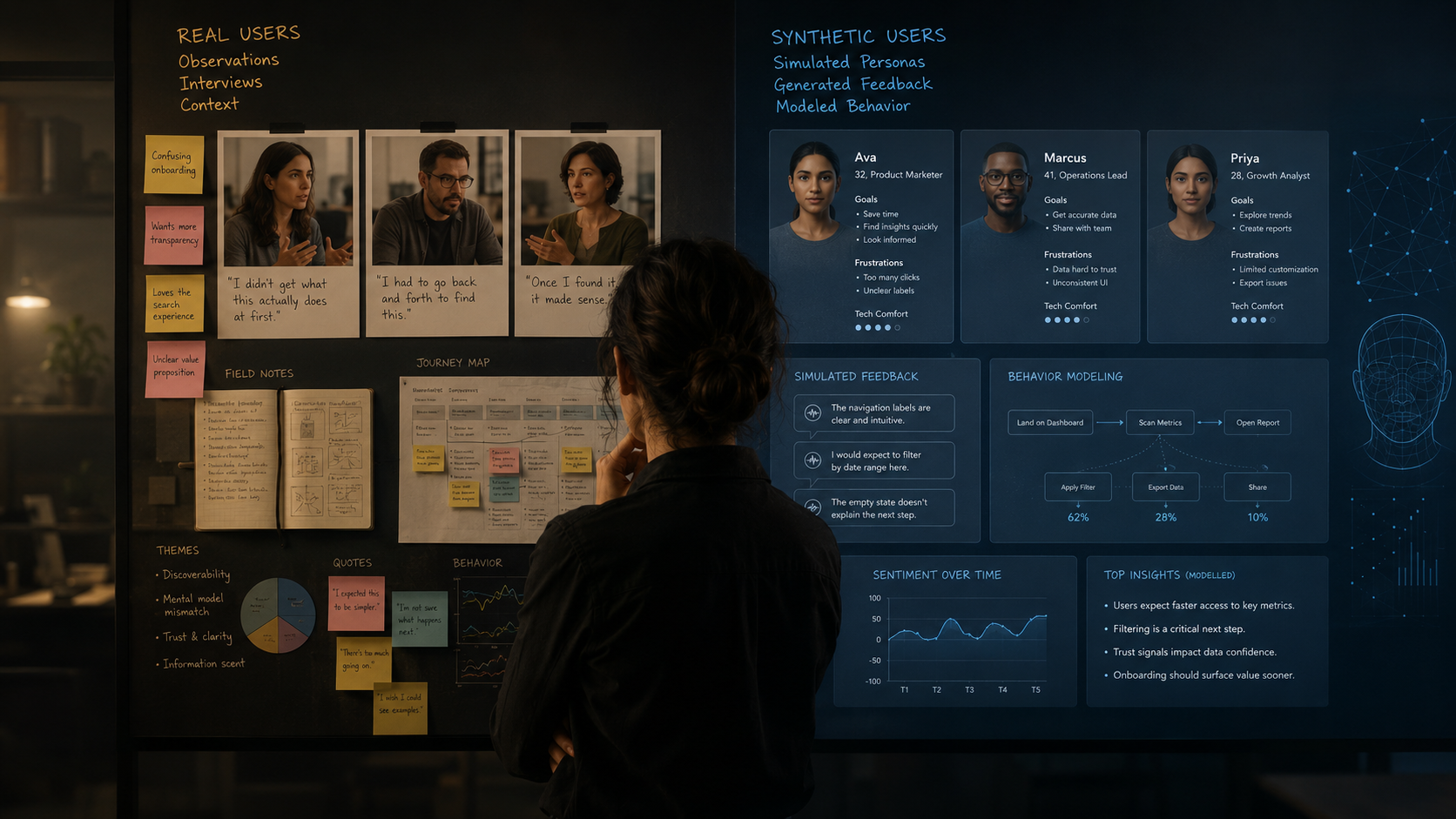
Synthetic users are one of the most seductive ideas in contemporary UX research. Give an AI a persona, ask questions, receive articulate feedback in seconds. No recruitment. No scheduling. No incentives. No awkward silence on Zoom.
That convenience is precisely why we need to be careful.
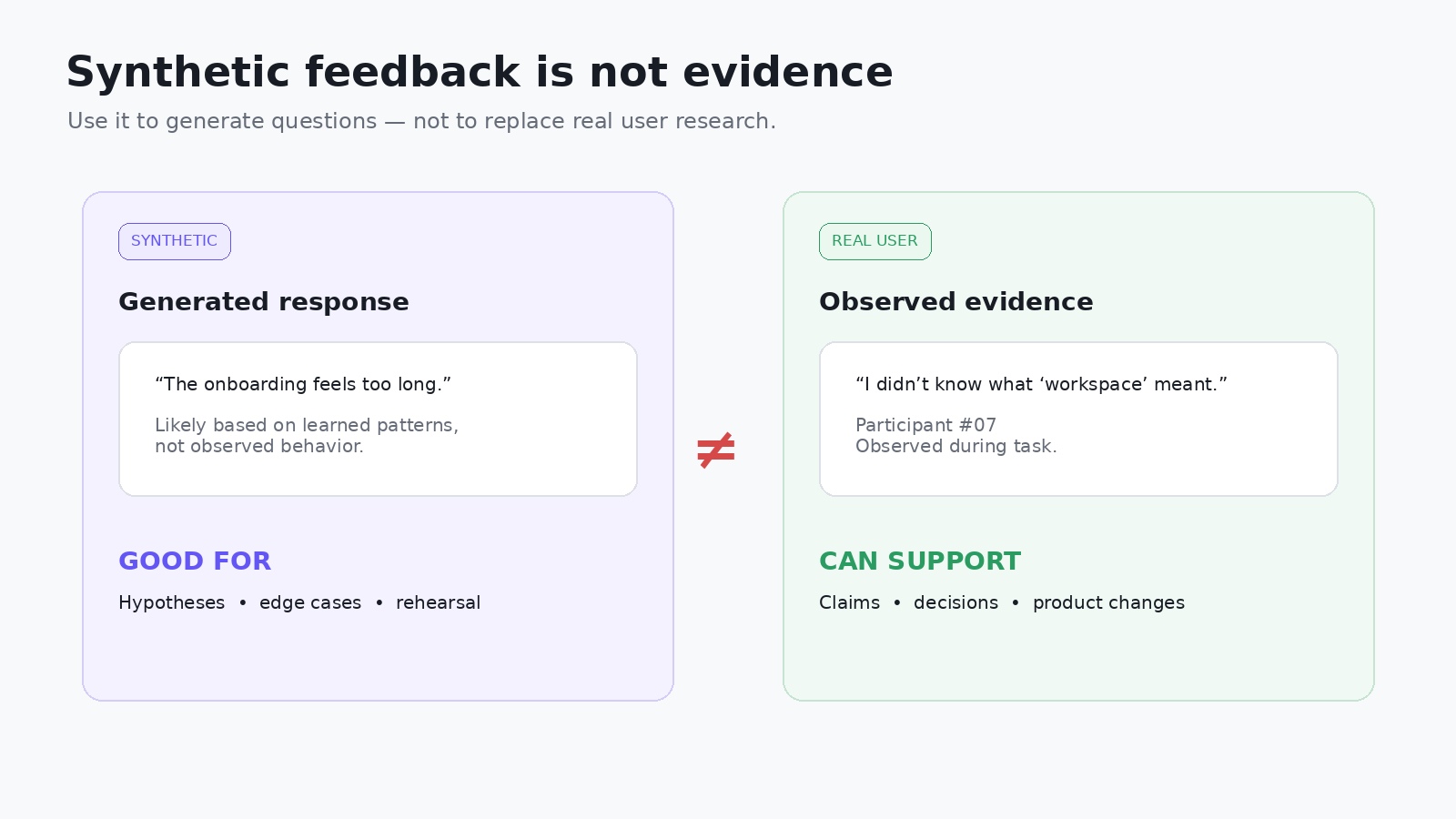
A synthetic participant can generate plausible language. It cannot give you direct evidence of how your actual customers understand your product, what they notice, what they ignore, how they behave under pressure, or what unexpected workaround they have invented.
The useful framing is simple: synthetic users are simulations, not participants.
Why synthetic feedback feels more trustworthy than it is
Large language models are extremely good at producing coherent explanations. UX researchers are trained to listen for patterns in explanations. That combination creates a risk: generated responses can feel like research data even when they are model predictions constructed from training patterns and the context you supplied.
A real participant can surprise you because their behavior emerges from a life you did not write into the prompt.
A synthetic user is bounded by the frame you created.
Bad use: replacing interviews
The clearest misuse is generating ten personas and “interviewing” them as a substitute for recruiting ten users.
You have not sampled a population. You have sampled variations of a model conditioned by your prompt.
If all ten synthetic users complain that navigation is confusing, that does not tell you that customers find navigation confusing. It tells you that, given your description, the model found that criticism plausible.
Good use 1: improve your research plan
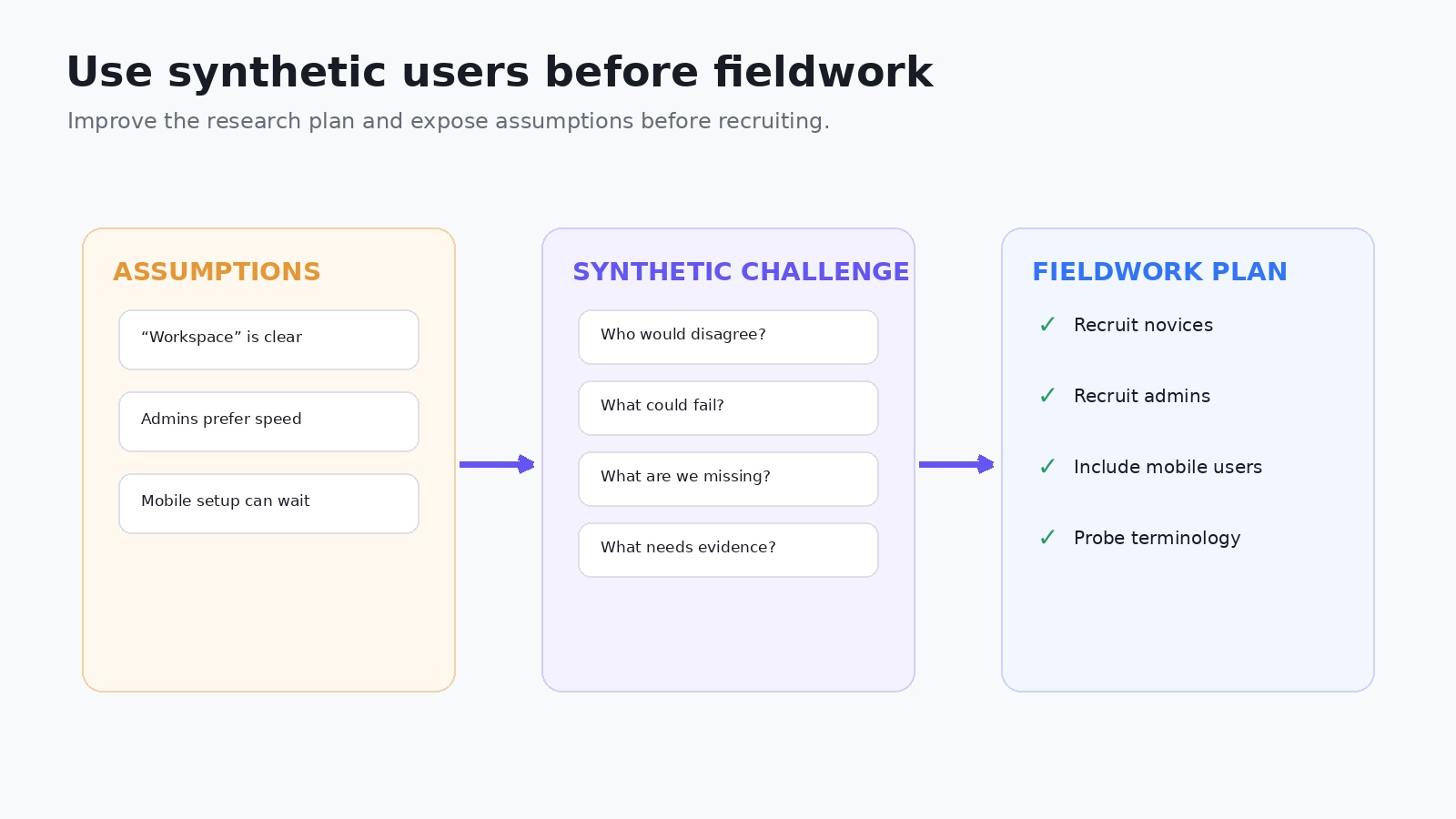
Before real research begins, synthetic users can help you test the quality of your questions.
Give the model the study goal and interview guide. Ask it to role-play several plausible participant types, then flag:
- leading questions;
- questions likely to produce vague answers;
- missing follow-ups;
- concepts participants may not understand;
- areas where the guide assumes too much product knowledge.
You are not learning about users. You are improving the instrument you will use with users.
Good use 2: generate hypotheses before fieldwork
Imagine you are researching why trial users fail to activate a collaborative feature.
You can ask AI to generate possible explanations across categories:
- discoverability;
- mental model;
- trust;
- permission anxiety;
- value perception;
- organizational constraints.
These are hypotheses, not findings. The value is breadth. The model can help you remember alternative explanations before you enter interviews with a favorite theory.
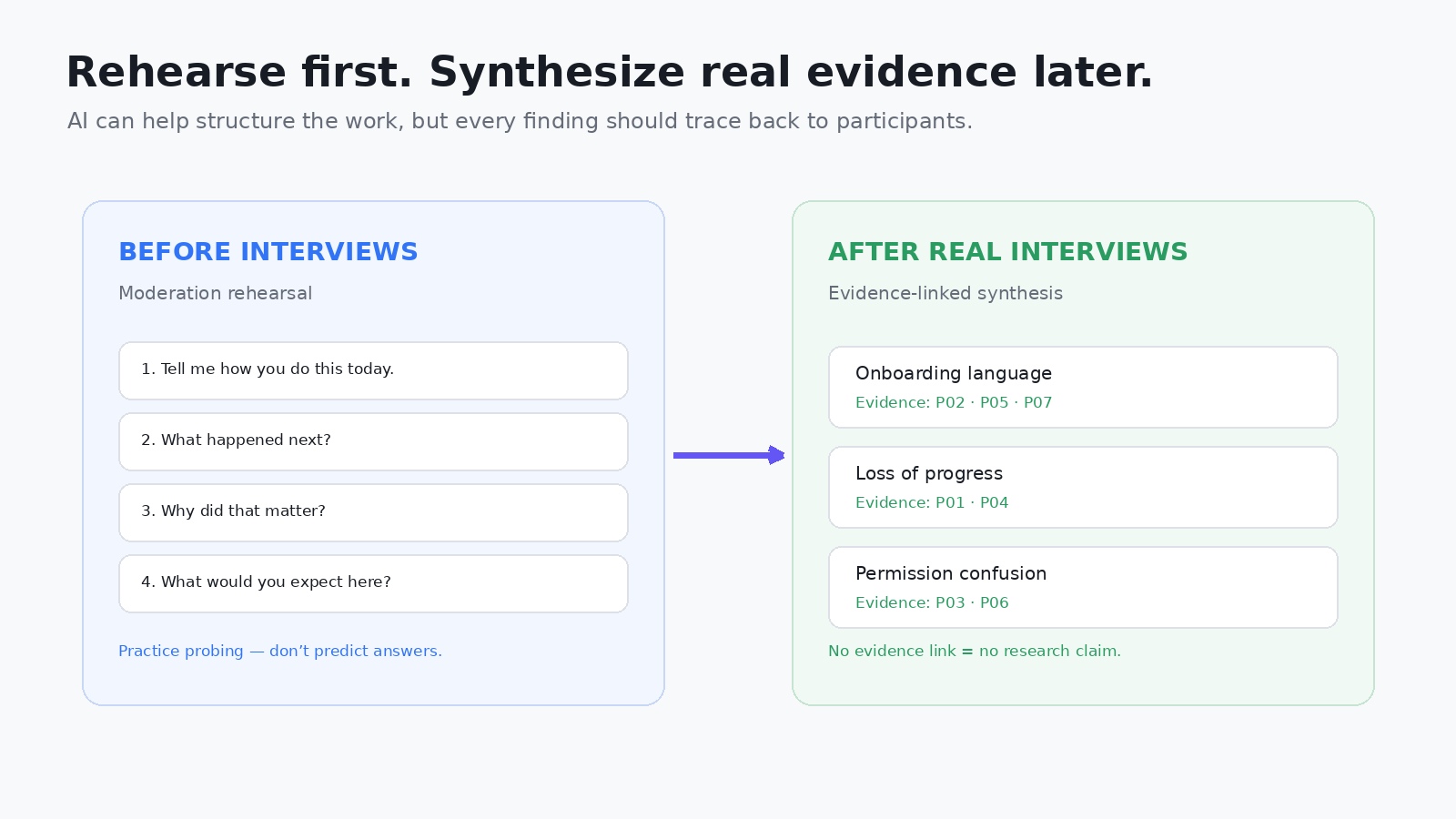
Good use 3: stress-test a concept
Early concepts often benefit from adversarial review.
Ask the synthetic user to behave as:
- a skeptical enterprise administrator;
- a first-time user with limited technical vocabulary;
- a privacy-sensitive customer;
- a user trying to finish the task on mobile;
- a user with low motivation and little time.
The feedback can expose obvious assumptions before you spend participant time on them. Again, the value is not truth. It is inexpensive challenge.
Good use 4: rehearse moderation
Moderation is a skill. Synthetic role-play can help junior researchers practice follow-up questions, silence, probing and neutral phrasing.
Ask the model to provide messy, incomplete, contradictory answers rather than idealized research responses. Then practice extracting detail without leading the participant.
That is closer to training than research, and it is genuinely useful.
Good use 5: test your synthesis framework
If you are designing a tagging taxonomy or research repository workflow, generated sample notes can be useful test data.
Create artificial interview snippets explicitly labeled as synthetic, then see whether your coding scheme can handle contradictory evidence, multiple themes in one quote, weak signals, outliers, and missing context.
You are testing the research system, not producing product evidence.
Good use 6: explore extreme scenarios
Real research samples are always limited. Synthetic scenarios can help a team imagine edge conditions worth recruiting for later.
For example: “What could go wrong for a finance administrator who manages 15 legal entities, has intermittent connectivity and requires dual approval?”
If the generated scenario reveals a meaningful risk, recruit a real person who can validate whether that risk exists.
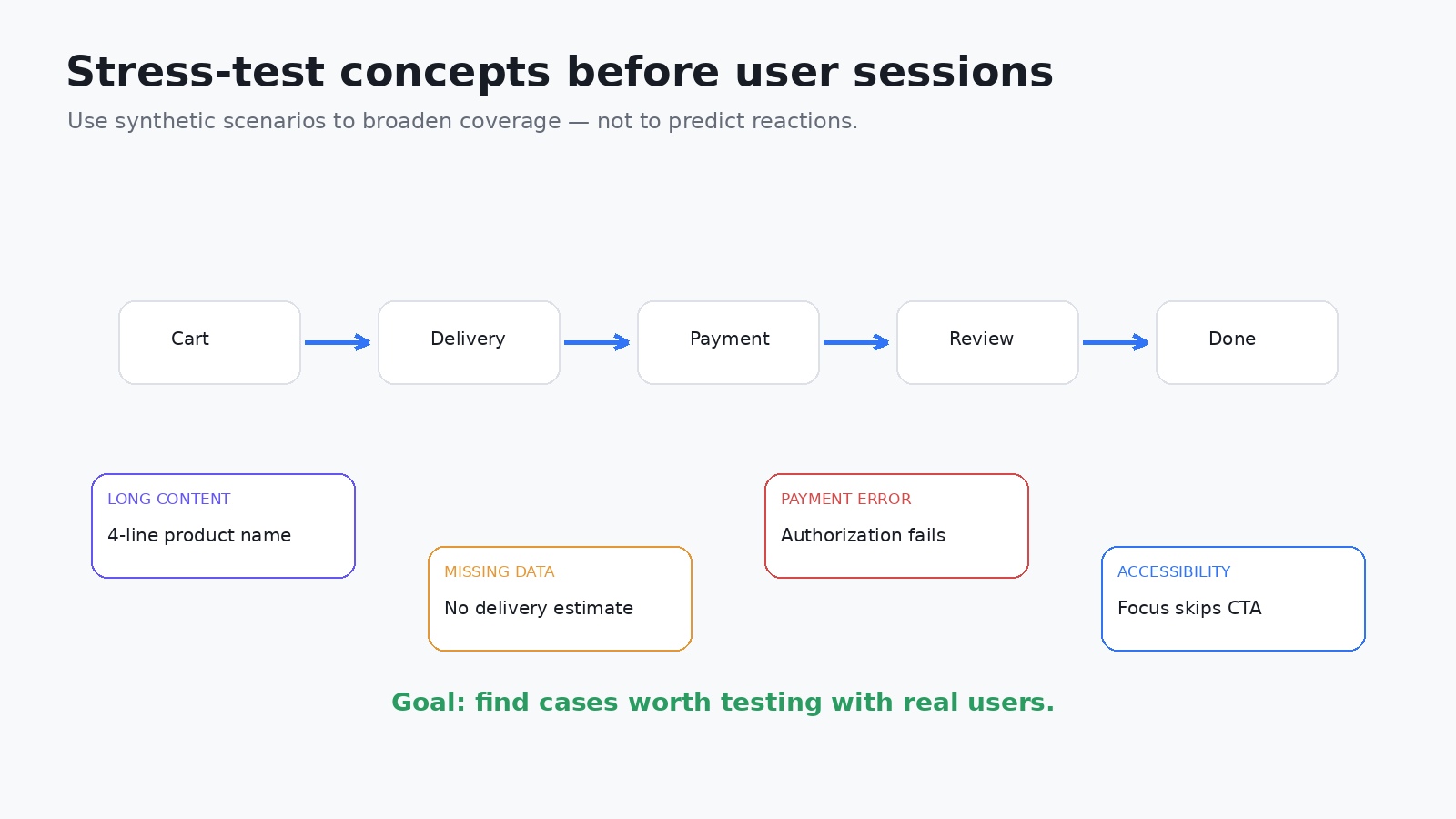
A simple evidence ladder
I find it useful to classify outputs into four levels:
- Generated possibility: AI proposed it.
- Internal observation: team or support data suggests it.
- User evidence: real participant behavior or statement supports it.
- Behavioral evidence: product data or observed usage confirms scale/pattern.
The mistake is promoting level one directly to level three.
Keep synthetic and real data visibly separate
If your repository mixes generated material with research transcripts, you are creating future confusion.
Label synthetic artifacts aggressively. Separate folders. Separate tags. Separate dashboards if necessary.
A future designer should never open a quote and wonder whether a customer actually said it.
Use AI after real interviews, carefully
AI can be valuable in synthesis after real research: summarizing notes, clustering observations, proposing themes and identifying contradictions.
But preserve traceability. Every theme should link back to real evidence. If the model produces a clean narrative that the raw interviews do not support, the narrative is wrong.
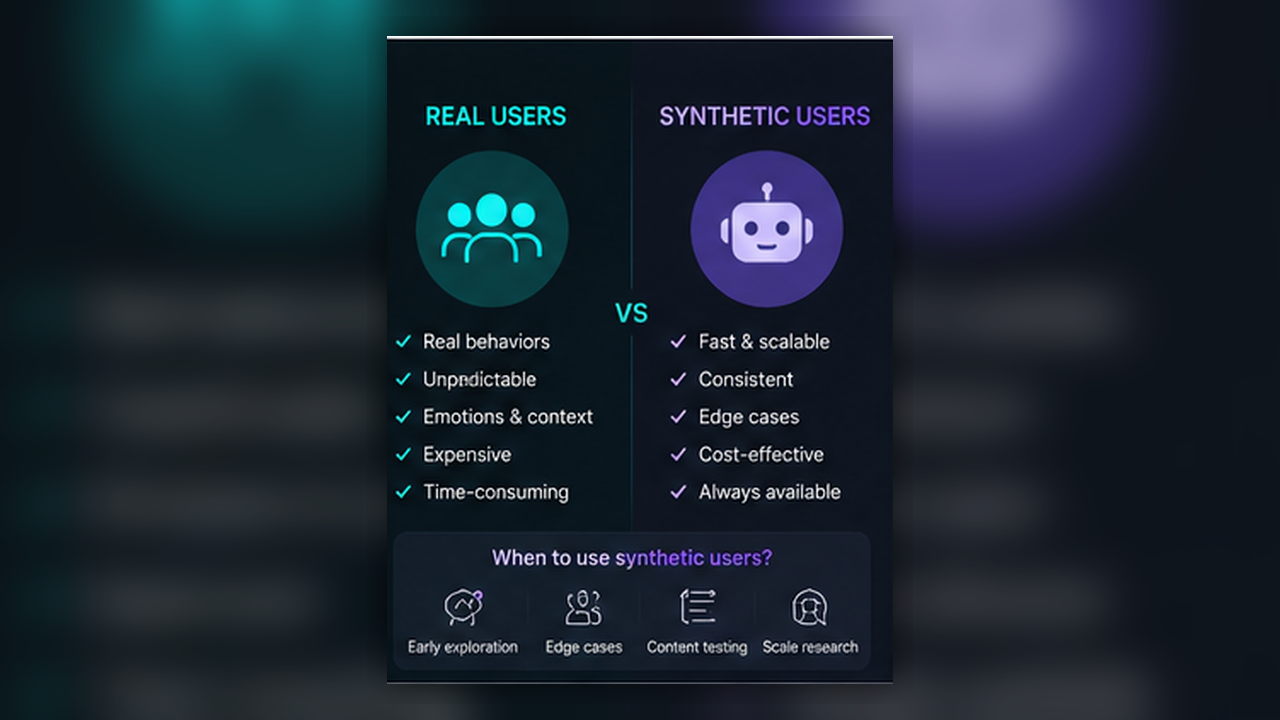
A practical workflow
- Write your research question.
- Use AI to generate competing hypotheses.
- Use synthetic role-play to improve the guide.
- Conduct real research.
- Use AI to assist organization and synthesis.
- Trace every important conclusion to real evidence.
- Use synthetic scenarios to stress-test candidate solutions.
- Return to real users for validation.
The standard should be usefulness without epistemic confusion
The right question is not “Are synthetic users good or bad?”
The right question is: what kind of claim am I allowed to make from this output?
If AI generated a concern, you can say it is a concern worth investigating. You cannot say users have that concern.
If AI simulated a usability problem, you can fix an obviously weak design. You cannot claim the new version tested better.
That distinction sounds academic until decisions, budgets and roadmaps begin citing fictional evidence.
Use simulation to protect real research, not replace it
The best role for synthetic users may be to make real research more valuable: better questions, broader hypotheses, stronger scenarios and fewer wasted sessions.
They can help us arrive at a participant conversation better prepared. They cannot have that conversation for us.
How to prompt a synthetic user responsibly
If you use simulation, make the prompt explicit about its limits. Instead of “You are a user from our target audience,” describe the exercise as hypothesis generation.
For example: “Simulate possible reactions from a time-poor operations manager encountering this workflow. These responses are not research evidence. Generate five plausible concerns, including at least two that contradict each other. For each concern, state what real research would be required to validate it.”
Never generate fake quotes for stakeholder decks
Quotes carry disproportionate emotional weight. A sentence in quotation marks looks like a person said it.
If the content was generated, do not present it in the visual language of research evidence. Call it a scenario, hypothesis or simulated reaction.
Beware the average-user effect
Models are good at producing plausible median behavior. Many of the most valuable UX findings come from specific constraints, unusual workflows, strong motivations or organizational realities.
An enterprise procurement manager, a nurse in a noisy clinical environment and a teenager using a shared family device are not interchangeable “users.” Context is the research.
Beware confirmation loops
If you describe your solution enthusiastically, the synthetic user may reflect your framing back to you. Use neutral descriptions and explicitly request competing interpretations.
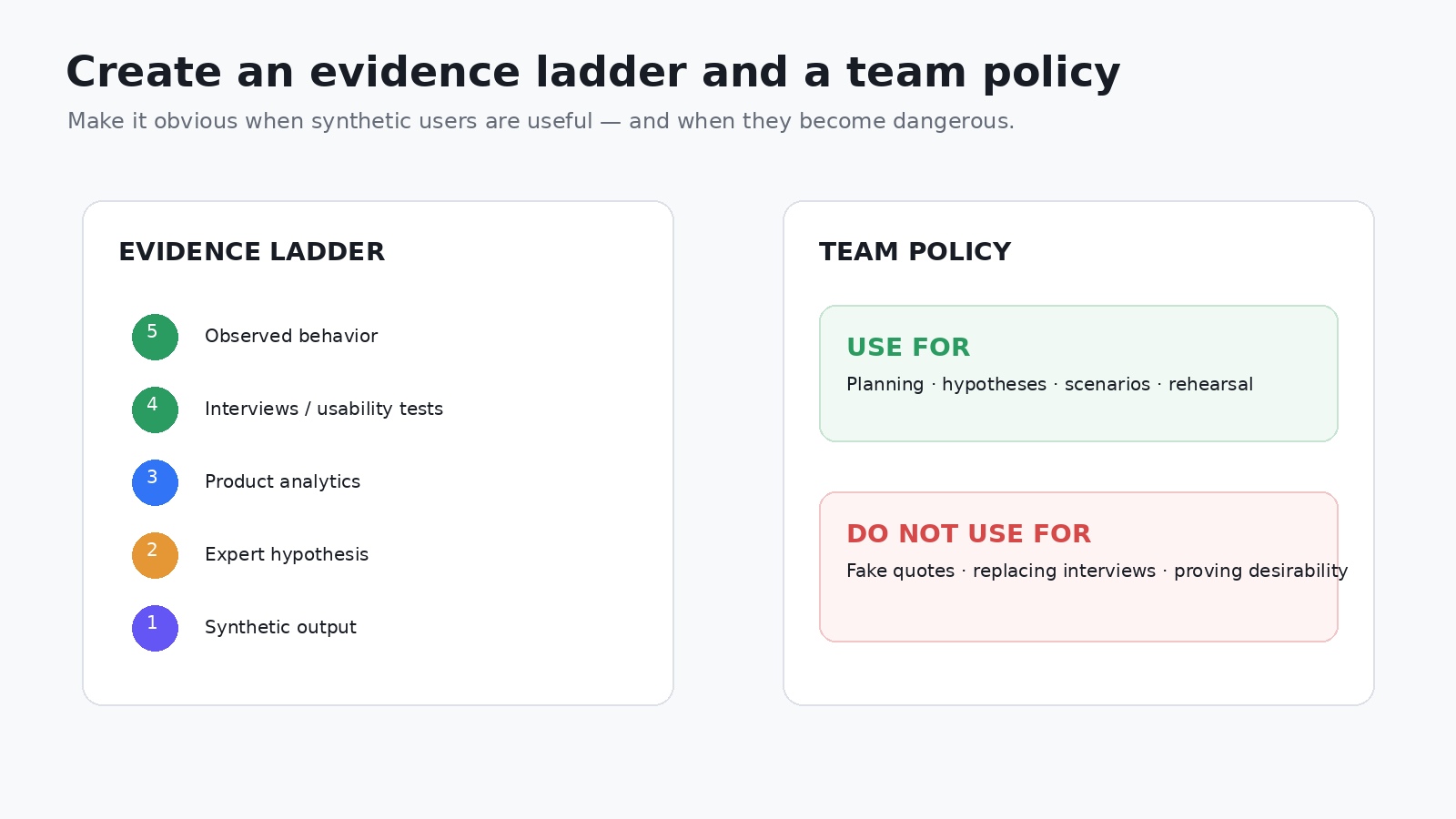
A team policy I would adopt
- Synthetic material is always labeled.
- It never appears in the repository as participant evidence.
- It can generate hypotheses, scenarios and research-planning ideas.
- It cannot validate product decisions.
- Any claim about real users requires real evidence.
- AI-assisted synthesis must remain traceable to source data.
When synthetic users become dangerous
The risk grows when generated outputs enter executive decision-making without provenance. Do not aggregate simulated personas into percentages that resemble market data. “62% of synthetic users preferred option A” is not a user insight.
When they become useful
They are useful when the output is treated as design material rather than evidence: something to question, rehearse, stress-test or explore.
The distinction is simple enough to remember: AI can help you prepare to learn from users. It cannot spare you the need to learn from users.