An employee asks a workplace assistant to organize a training session. One system finds available dates, another checks room capacity, and another prepares invitations. Much of the work can happen without anyone opening a calendar grid, a facilities dashboard or an email composer. It is tempting to conclude that interfaces are becoming unnecessary.
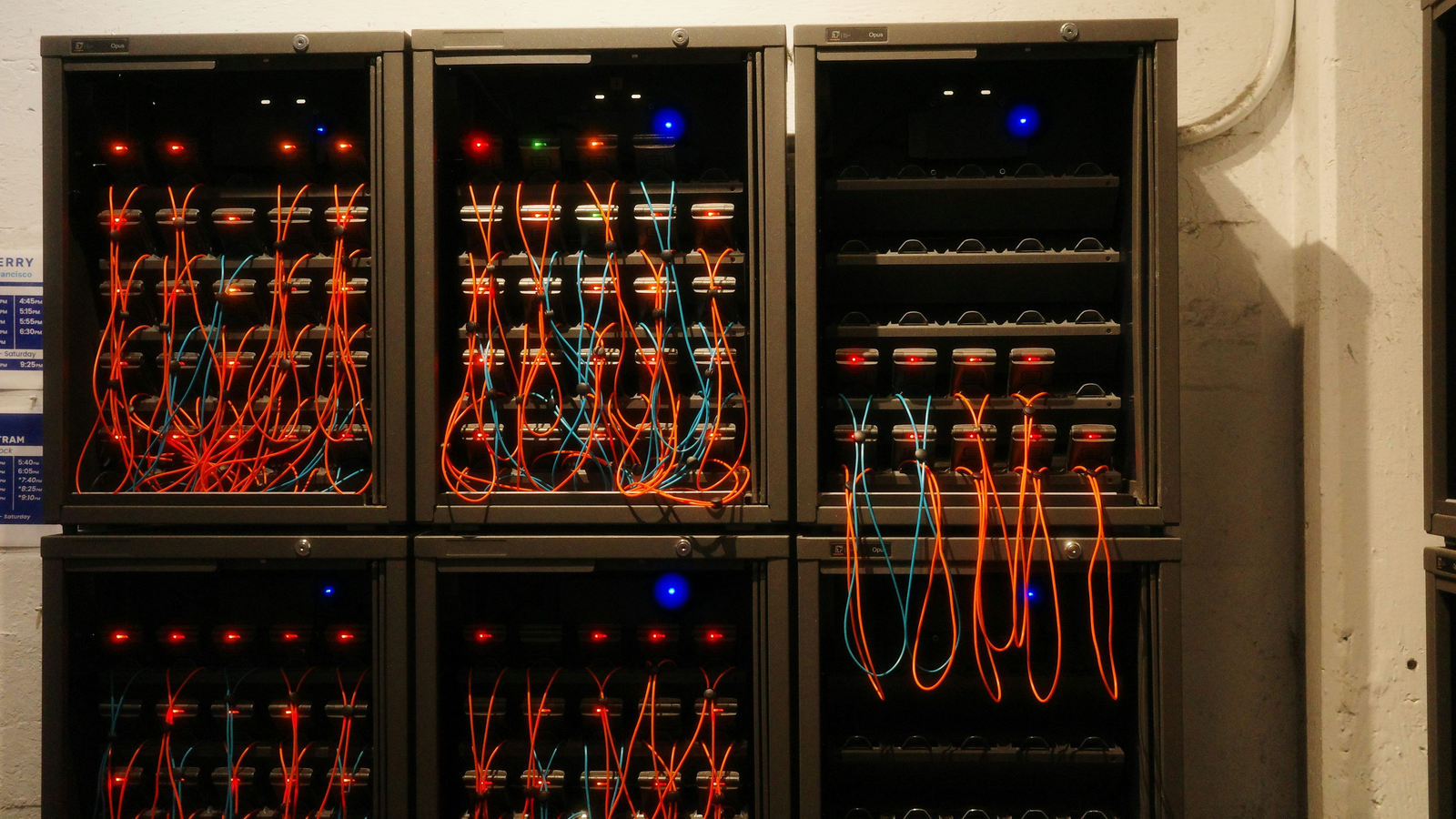
A physical network is an analogy for connectivity; it does not establish agent authority or reliability. Credit: Fabio Sasso / Unsplash.
The more useful question is where human understanding and control move when those screens disappear from the routine path. Someone still needs to understand the request, define its boundaries, judge exceptions, inspect consequential results and recover from mistakes. Removing the forms does not remove those responsibilities. It changes where they must become visible.
For a UX Lead, this creates a concrete design problem: which interactions can become background coordination, which should appear only when needed, and which deserve a persistent interface? The scenarios below are hypothetical design explorations. They are not predictions about a universal screenless future or claims that current protocols guarantee reliable autonomous behavior.
Separate machine communication from human authority
Agents communicating is not the same as agents having permission to act. A scheduling agent might understand a request from another system while lacking access to the employee's private calendar. A purchasing agent might receive a valid message but still require a person to authorize a new supplier. Connectivity and authority are different design layers.
The official A2A documentation describes a protocol for collaboration between agents. MCP addresses integrations between AI applications and external capabilities or context. These are useful technical foundations to understand, but neither should be presented as a complete UX architecture. A shared message format does not determine which employee owns a decision or how a customer disputes an outcome.
Start a design workshop by drawing these layers separately. Map who exchanges information, who can change state, who is accountable, and what the person sees. A technical arrow between services should not silently become an authorization arrow. This simple distinction prevents impressive integration diagrams from hiding unresolved product decisions about control, scope and responsibility.
Inventory tasks rather than predicting which screens will die
A screen often contains several kinds of work. A procurement dashboard may support monitoring, comparison, exception handling and record inspection. Agents might automate routine monitoring while humans still need to compare unusual proposals. Calling the whole dashboard obsolete obscures which tasks have actually changed and which still require careful interaction.
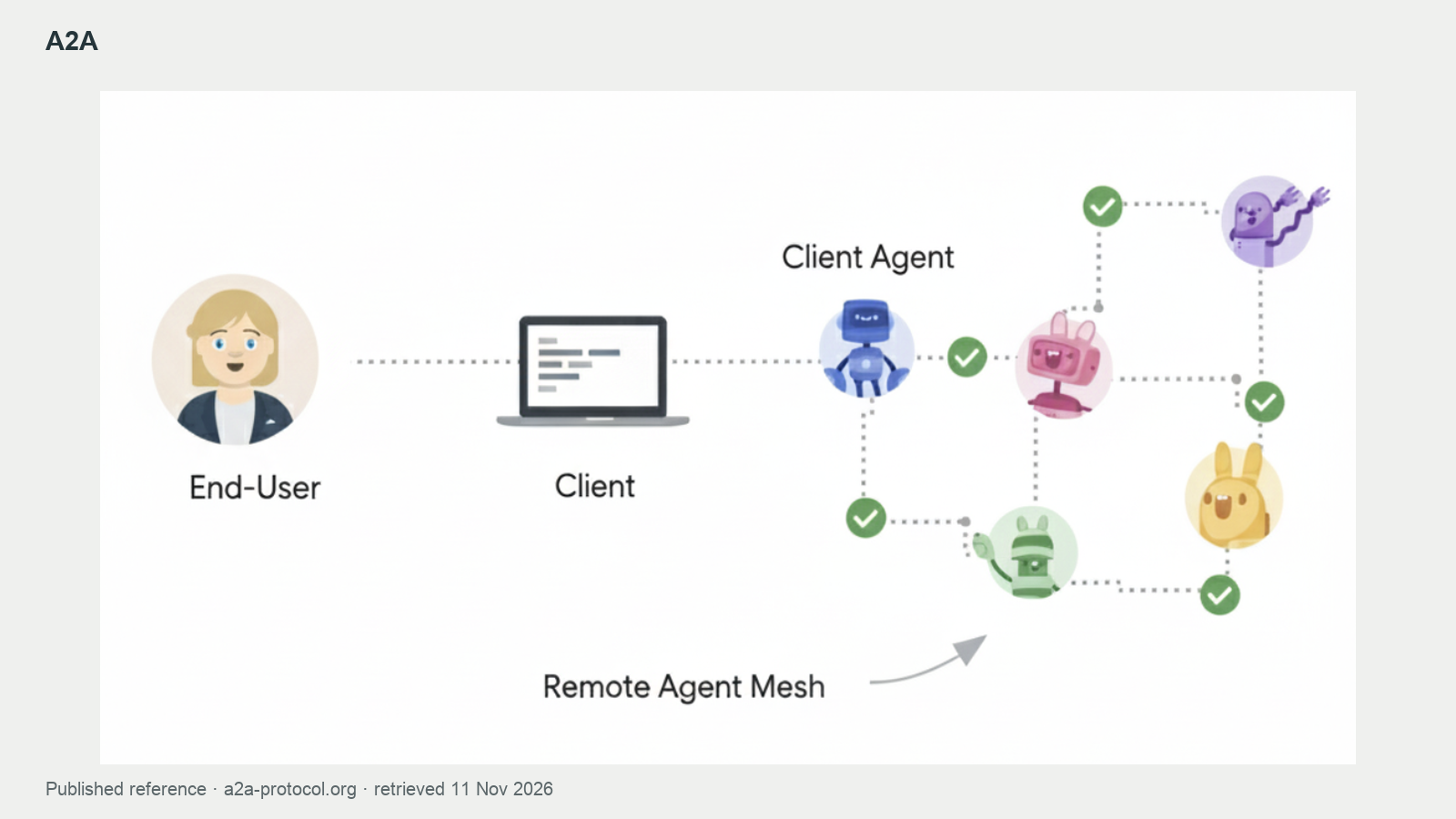
The A2A documentation illustrates actors and communication. A protocol diagram does not establish organizational authority. Credit: A2A / official documentation.
Create a task inventory with triggers, information needs, consequences and recovery options. For each task, ask whether the person needs to formulate intent, inspect evidence, choose among alternatives or merely receive a confirmed result. Also ask how often the task occurs and how much context the person needs to rebuild when it appears unexpectedly.
This may lead to a smaller persistent workspace rather than no workspace. Routine renewals can run within agreed boundaries, while a review queue holds changes outside those boundaries. Record inspection remains available even when nobody needs to visit it daily. The goal is to remove unnecessary navigation while preserving an understandable route into the consequential parts of the service.
Use three interface modes deliberately
I would distinguish persistent, situational and background interaction. Persistent surfaces support ongoing orientation: active work, commitments, settings and history. Situational surfaces appear around a specific decision, such as choosing between two available dates. Background coordination handles work inside a previously agreed scope and reports meaningful outcomes or exceptions.
These modes can coexist within one workflow. The training request may begin in a persistent team workspace, use background availability checks, and surface a situational decision when no room fits the requested group. After completion, a durable record shows what was booked and which invitations were actually sent. The user does not need to reconstruct events from transient chat messages.
Choose the mode by task characteristics rather than visual fashion. A recurring comparison may deserve a stable table. A rare clarification may need only a compact form. A silent background action needs reliable boundaries and a discoverable history. Generating an entirely new interface for every interaction can impose learning costs even if the technology makes that generation easy.
Design a delegation agreement people can inspect
Before background coordination begins, make the scope understandable. For the training example, the agreement might permit internal calendar holds during working hours, exclude external invitations, and require review before booking a paid venue. The person should be able to recognize those boundaries without reading a policy engine or composing a sophisticated prompt.
The agreement should persist beyond the initial conversation. Show which preferences are personal, which belong to the organization, and which are specific to this task. If an administrator changes a policy, explain the practical effect on active work. A previously valid request may now require review, and the product should identify that change rather than silently using whichever interpretation is convenient.
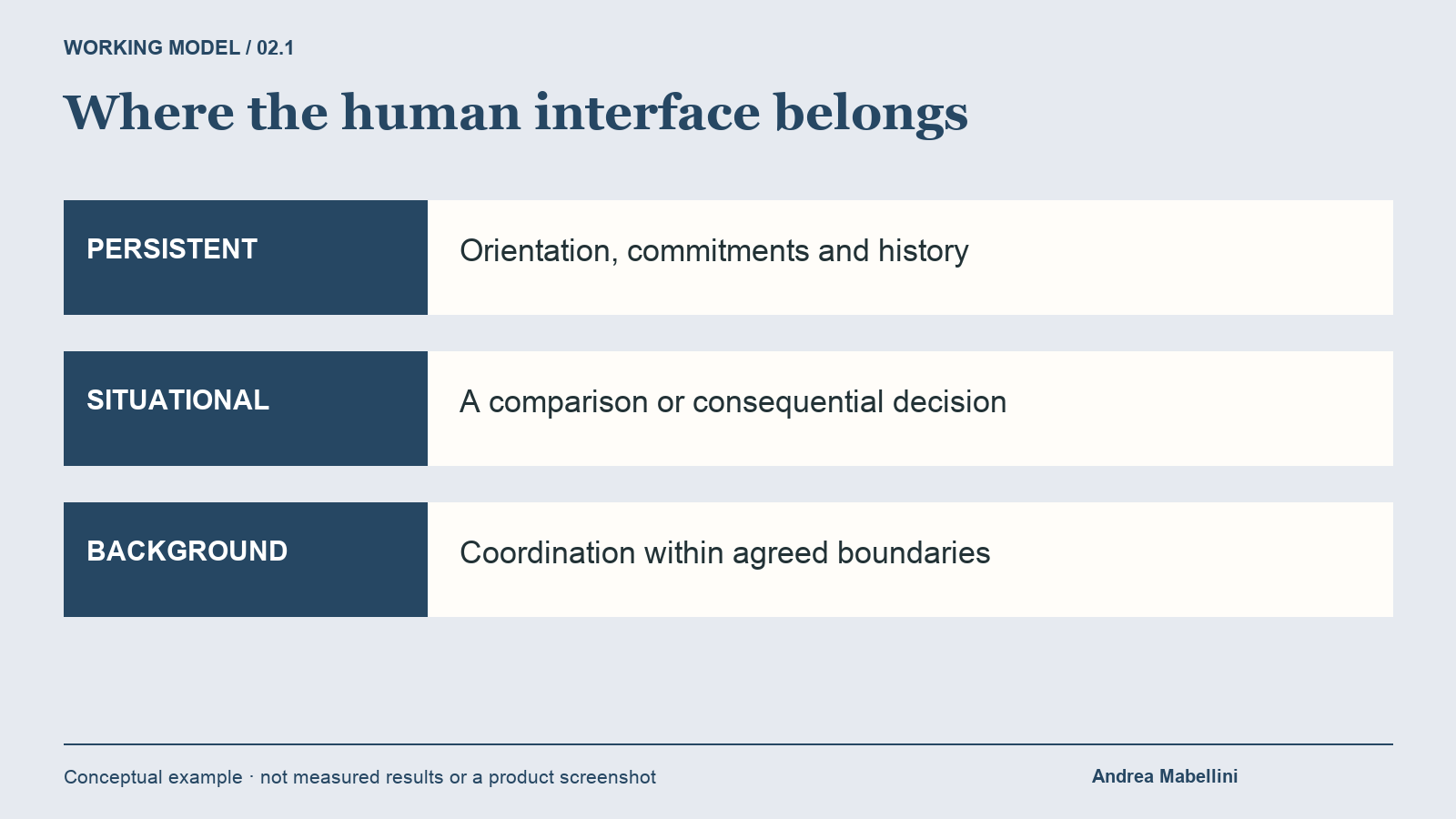
Where the human interface belongs. Original conceptual working model; no measured results. Credit: Original editorial visual prepared for Andrea Mabellini.
Avoid treating one approval as unlimited future consent. Permission to prepare a training proposal does not establish permission to send invitations, purchase catering or reuse attendee information elsewhere. Designers should work with engineering and service owners to define the actual authority model, then express it through concise controls and recognizable task states. The interface is the readable face of that model.
Make multi-agent work legible at the level of outcomes
Most people do not need a live transcript of agents exchanging messages. They need to know whether the requested task is active, what has been committed, what is blocked and what requires their decision. A useful progress view might say that suitable times were found but venue confirmation is still pending. It should distinguish that from a completed booking.
Offer deeper inspection when the task warrants it. A service administrator investigating repeated failures may need to know which system rejected a request and what information was missing. A requester may only need an explanation and a next step. Role-specific detail is more useful than exposing the same technical event stream to everybody.
Preserve a durable connection between the original goal and each meaningful action. If the training agent creates a calendar hold and later releases it, the history should show both. If another agent sends the invitation, the overall task should not claim completion before that action is confirmed. Coordination quality becomes visible through accurate state, not animated representations of agents talking.
Keep comparison interfaces where comparison is the work
Conversational input can be convenient for expressing intent, but reading long paragraphs is often a poor way to compare alternatives. If three venues differ in capacity, access, equipment and cancellation conditions, a structured comparison may be easier to inspect. The user should not need to remember one paragraph while reading the next.
Generate or populate the comparison from the current task, but preserve stable meanings. Label missing information explicitly. Keep units consistent. Identify whether a value is confirmed by the source or inferred by the system. Let the person inspect the evidence behind a consequential difference instead of making a decision from an untraceable summary.

An industrial workspace illustrates the need for human inspection around coordinated systems. Credit: Skellefteå kommun / Unsplash.
The same principle applies to account reconciliation, project prioritization and content review. Some traditional interfaces survive because they externalize cognitive work effectively. A table, timeline or document can remain the right interaction even when agents assembled its contents. UX work shifts from drawing every intermediate screen to deciding which representations make human judgment reliable at the moments it matters.
Treat interruptions as designed handoffs
When background work needs a person, the interruption should carry a decision packet. Include what the system attempted, the unresolved issue, the viable choices and the effect of each choice. “Something went wrong” forces the person to investigate the workflow before they can even understand what is being asked.
In the training scenario, a useful interruption might explain that the available accessible room cannot accommodate the full group on the requested day. Offer meaningful alternatives, such as changing the date or splitting the session, and state which arrangements are only provisional. Do not make the user approve a vague exception whose operational consequences remain hidden.
Timing also matters. A low-priority clarification can wait in a queue. A reservation about to expire may require an explicit deadline. The product should establish where responsibility goes if nobody responds. Background coordination that depends on a person eventually noticing a message is still a fragile workflow, regardless of how capable the agents appear during a demonstration.
Plan for disagreement and partial completion
Agents may produce conflicting interpretations, receive inconsistent data or complete only part of a task. The interface should represent those conditions directly. A booking might be confirmed while invitations remain unsent. A directory might list one manager while a project system names another. Neither condition should be compressed into a single reassuring success state.
Assign a source of authority for important fields. When two systems disagree, the resolution should follow an agreed rule or a named human decision. Asking another model for the most plausible answer may help investigate, but it does not establish organizational authority. The person resolving the conflict needs to know what will change and which downstream actions depend on the result.
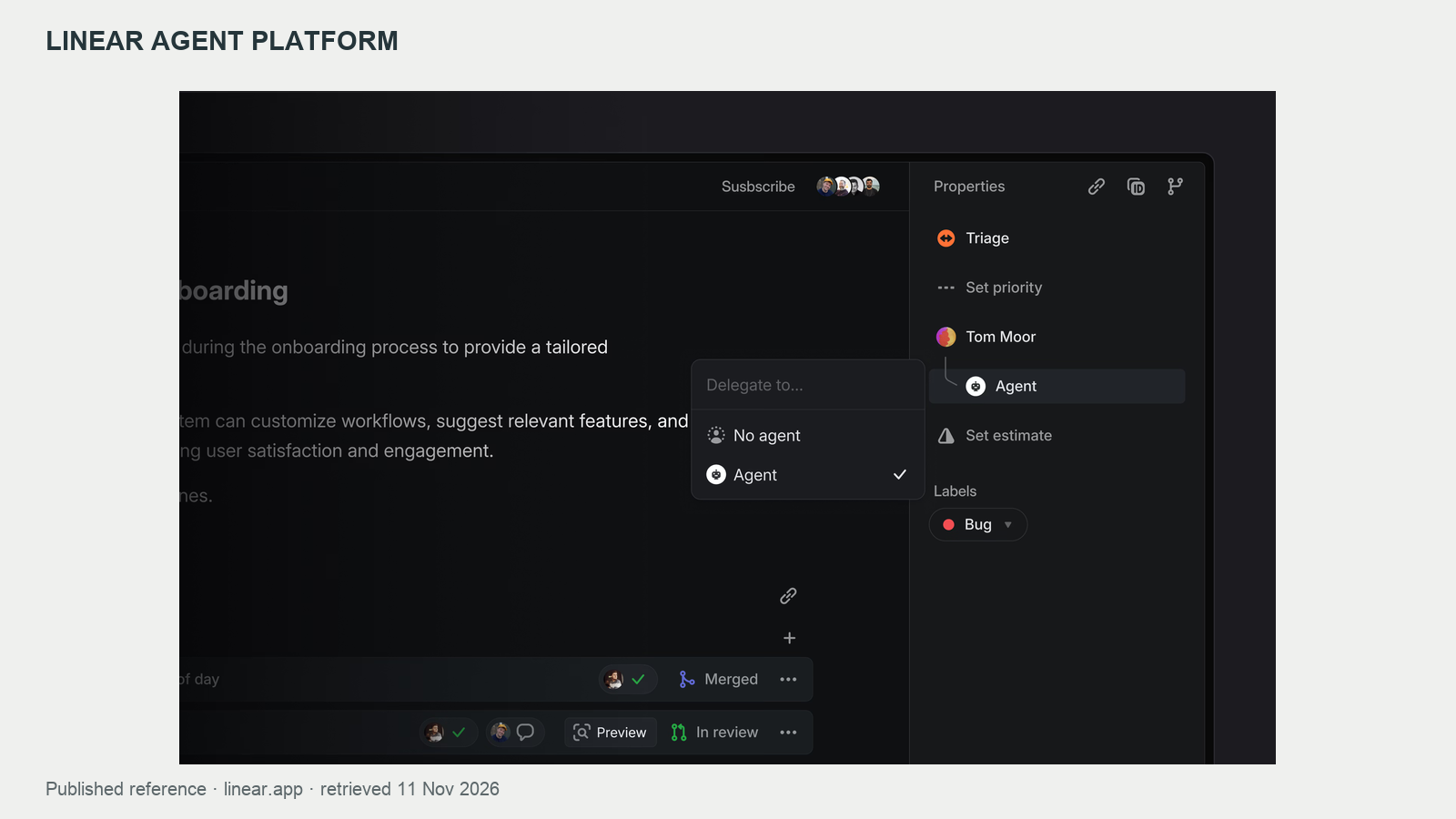
Linear’s published assignee-menu example makes agent delegation visible inside an existing work surface. Credit: Linear agent platform / official documentation.
Design recovery at the level of the actual commitments. Releasing a room is different from retracting an invitation someone has already read. If a task partially completed, show what can still be undone and what requires a compensating action. A generic retry button can create duplicate commitments when the outcome of an earlier request remains uncertain.
Test comprehension before celebrating autonomy
A successful demonstration often shows a clean request followed by a completed outcome. A meaningful usability study should include interruptions, contradictions and delayed results. Ask participants to explain what they believe has already happened, what the system is allowed to do next, and how they would stop or correct the work.
Include people who were not present when the task began. A colleague taking over responsibility should be able to find the agreement, current state and outstanding decision. This tests whether the interface supports organizational continuity rather than only a satisfying conversation for the original requester. Enterprise workflows commonly outlive a single person's attention or availability.
Observe behavior as well as verbal confidence. Do participants inspect evidence when the decision warrants it? Can they distinguish a proposed invitation from a sent one? Can they locate a failed subtask without restarting everything? Positive reactions to a minimal interface do not establish that the service remains understandable when coordination becomes complicated.
Change the design team's deliverables
Design teams will still create interfaces, but the specification should include more than screen sequences. Document delegation boundaries, task states, interruption rules, evidence requirements and recovery paths. These artifacts help engineering implement behavior that remains coherent across services, even when the visible interface changes according to the task.
Prototype a complete lifecycle before polishing the most attractive moment. Start with a request, show the interpreted scope, introduce a realistic conflict, require a decision, and end with a durable outcome record. Include a second actor who needs to inspect the history. This exposes gaps that a single conversational happy path will miss.
The design system may need components for pending commitments, evidence previews, scoped permissions, partial outcomes and task receipts. Reuse these patterns across products so people do not need to learn a different meaning for “ready” in each assistant. Protocol interoperability helps systems communicate; interaction consistency helps people understand the work those systems perform on their behalf.
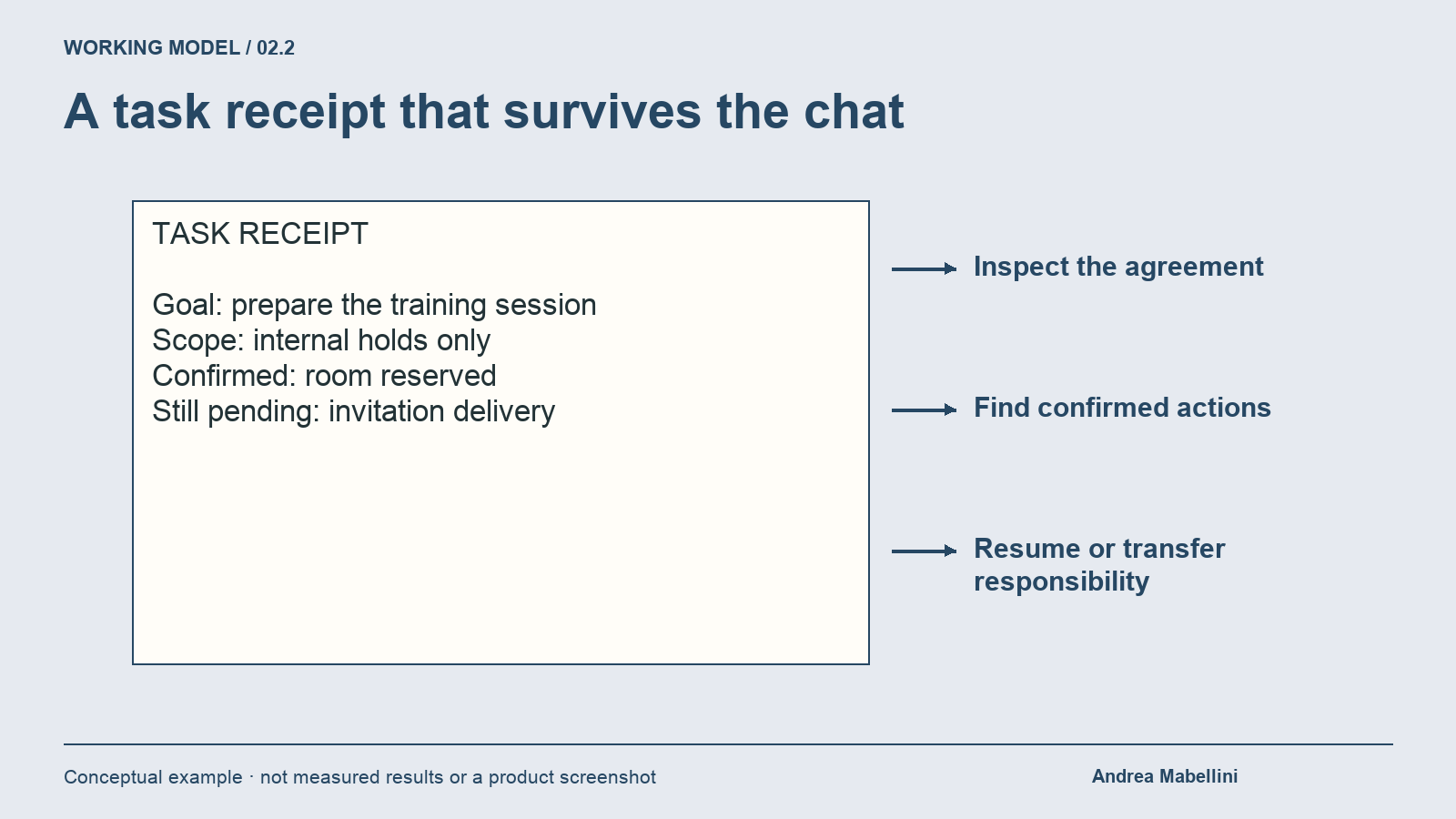
A task receipt that survives the chat. Original conceptual working model; no measured results. Credit: Original editorial visual prepared for Andrea Mabellini.
Decide what must remain stable when the interface is generated
Situational interfaces can adapt to a task without changing the meaning of familiar controls. Decide which elements must remain consistent: how a person reviews a commitment, how uncertainty is shown, where cancellation lives and how completed actions are distinguished from proposals. Generating a new layout should not require the person to relearn the service's basic grammar.
Create a small acceptance checklist for generated decision surfaces. Does the view identify the task and responsible actor? Does it expose the evidence needed for this choice? Does the primary action describe the commitment? Can the person return later and inspect the outcome? Test different generated views against the same criteria. This lets the design system support flexible presentation while preserving a dependable relationship between what the user sees and what the service does.
A worked example: a training session without a dashboard tour
Imagine a hypothetical operations lead requesting a training session for two teams. The system confirms the group, time window and authority: prepare a proposal and place temporary internal holds, but do not send invitations or spend money. This confirmation is compact because the task is familiar, with an option to inspect the full standing agreement.
Agents then coordinate calendars and room information. The requester returns to other work. A situational interface appears only when the available room lacks required equipment. It presents two alternatives with the relevant evidence, identifies the unresolved equipment cost, and explains when the temporary hold expires. The requester chooses a different day rather than authorizing an unplanned purchase.
Before invitations are sent, the product shows a review surface containing attendees, location, timing and message. Once approved, the task receipt distinguishes confirmed room booking from invitation delivery. A persistent workspace keeps the record available for an assistant who later needs to change the session. Most intermediate screens were unnecessary, but several carefully chosen interfaces were essential.
That is the direction I would design for: fewer obligatory visits to software, stronger interfaces at moments of human responsibility, and a durable way to inspect what happened. Agent communication may remove routine interaction steps. It increases the importance of making intent, commitments and exceptions understandable. The future of UX is not decided by whether a screen exists, but by whether people can still direct and account for consequential work.
Sources and further reading
- A2A — Official documentation — Agent collaboration protocol; does not establish product authority or guarantee autonomous success.
- MCP — Introduction — Connections between AI applications and external systems; distinct from organizational permission.
- Microsoft Research — Guidelines for Human-AI Interaction — Communication, correction and behavior over time; not evidence for a productivity percentage.